Some interesting security talks from the videos posted on YouTube from last year's LocoMocoSec: Hawaii Product Security Conference (LocoMocoSec 2019: Kauai)
See full list of videos here
Showing posts with label Conference. Show all posts
Showing posts with label Conference. Show all posts
2020-03-28
2020-03-28 Saturday - LocoMocoSec 2019: Kauai
 This blog serves as my research notebook for a variety of topics that are of interest to me.
2019-09-24
2019-09-23 Monday - InsureTech Connect 2019 - Day #1
Day #1 - of InsureTech Connect 2019, Las Vegas, NV
(I'm still working on writing-up some pieces for the interviews with Gary and Bassam below - this posting will continue to be updated...)
I arrived late yesterday afternoon (Sunday) in Las Vegas. Checked into my hotel, near the MGM Grand - and walked over this morning for a 9am interview with Gary Hoberman, Founder and CEO of Unqork.
[Listening to Gary expound on his company's vision and mission was one of the most inspiring experiences I've had - not only while attending InsureTech Connect 2019 - but, probably in the last year.]
Unqork was founded in 2016 - and offers a cloud-based, no-code solution, with a market focus on Insurance, Financial Services, and Real Estate. A few interesting notes from my background research and interview with Gary:
The line to get to the registration desk was quite long...this process might benefit from an application of some technology. :)
Note: This was the view, after working our way ~50% through the queue...
While in line, I had the great pleasure of meeting Joseph Keller, Associate Counsel, Westmont Associates, Inc. I appear to have misplaced the business card of one of Joseph's associates that I also met (my apologies) - I will update this with her information as soon as I can find it. Later, I also had the chance to meet Logan Marro, Vice President.
Folks were still arriving throughout the day...
17:00
(I'm still working on writing-up some pieces for the interviews with Gary and Bassam below - this posting will continue to be updated...)
I arrived late yesterday afternoon (Sunday) in Las Vegas. Checked into my hotel, near the MGM Grand - and walked over this morning for a 9am interview with Gary Hoberman, Founder and CEO of Unqork.
[Listening to Gary expound on his company's vision and mission was one of the most inspiring experiences I've had - not only while attending InsureTech Connect 2019 - but, probably in the last year.]
Unqork was founded in 2016 - and offers a cloud-based, no-code solution, with a market focus on Insurance, Financial Services, and Real Estate. A few interesting notes from my background research and interview with Gary:
- Their Glassdoor employee reviews are quite interesting (14 reviews, 100% Recommend to a friend, and 100% Approve of CEO)
- Goldman Sachs is both a customer - and a lead investor (April 2019, $22M series A round)
- They have about 150 employees
- Interestingly, their software development is done entirely in-house, in New York.
- Given their stated position on not participating in RFPs (see their FAQ), I had assumed that they might have a market focus on the lower end of a target revenue size for their prospective clients - however, Gary surprised me with a few interesting facts:
- Their first customer writes over $48B in annual premiums
- None of their insurance customers write less than $1B in annual premiums.
- Gary mentioned that his view is that "...the idea of a policy admin system is flawed". This requires a bit more explanation - which I will expand on in the next day or so - but is it a teaser for you - of the radical and disruptive thinking that is embedded in the DNA of Unqork's approach to solving the historical problems/costs/challenges/delays in building information systems for the insurance industry.
- An astounding claim: They were able to port the PCE application for a client in Bogota, Columbia (22 products & riders) in 7 weeks.
- Cloud deployment is supported on Microsoft Azure, Google Cloud, and Amazon (AWS)
- The application is primarily written in JavaScript - for both the front-end, and back-end.
- JSON is heavily used in the application architecture - and is stored in MongoDB.
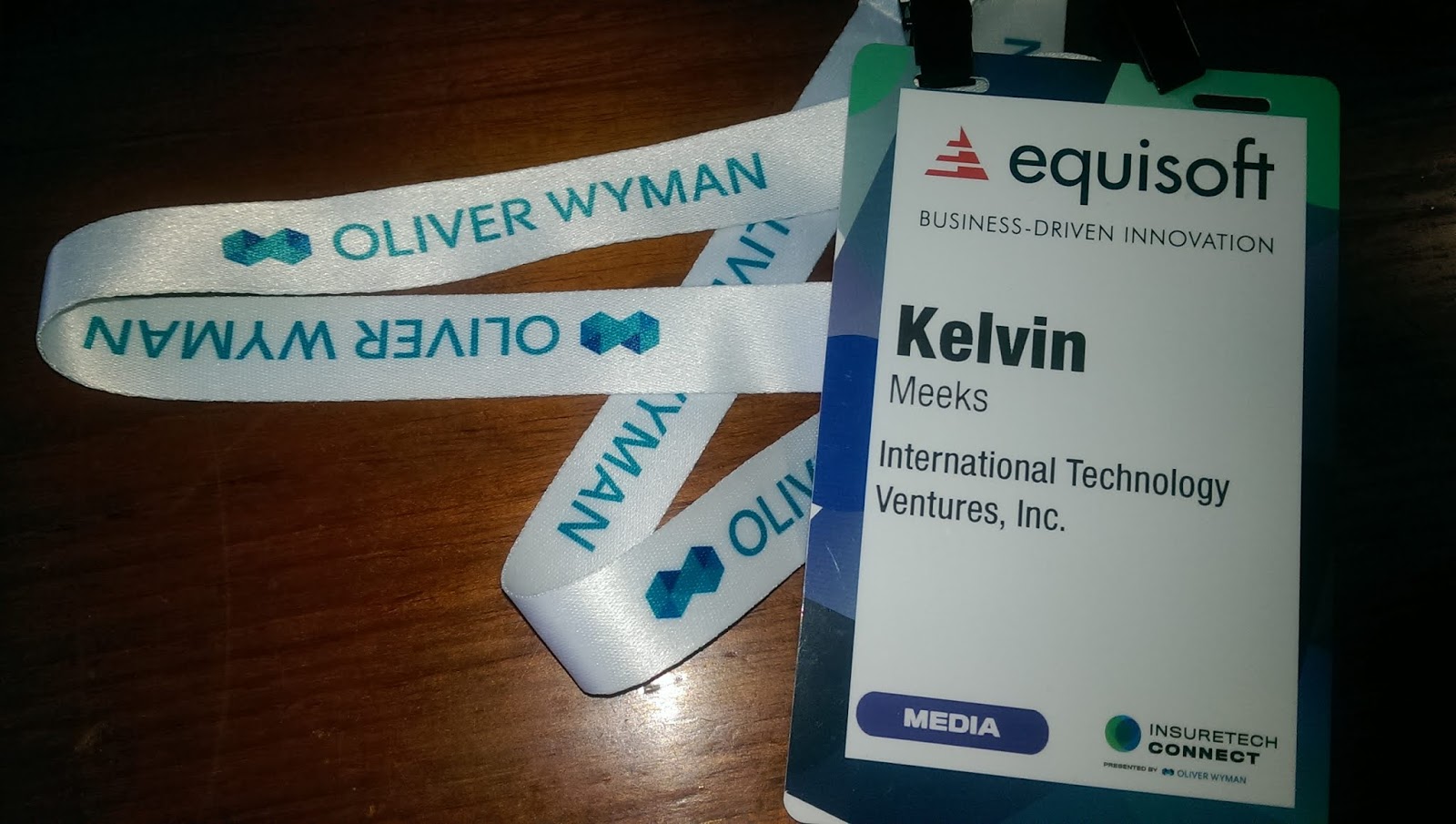 |
| Photo by Kelvin D. Meeks |
The line to get to the registration desk was quite long...this process might benefit from an application of some technology. :)
Note: This was the view, after working our way ~50% through the queue...
 |
| Photo by Kelvin D. Meeks |
While in line, I had the great pleasure of meeting Joseph Keller, Associate Counsel, Westmont Associates, Inc. I appear to have misplaced the business card of one of Joseph's associates that I also met (my apologies) - I will update this with her information as soon as I can find it. Later, I also had the chance to meet Logan Marro, Vice President.
"Westmont brings an unparalleled team of seasoned professionals, including contract/compliance specialists, attorneys, claims experts, accountants and actuaries. Our senior staff possesses insurance company experience and also includes former regulators. The principals on our staff have been senior executives at insurance companies throughout the U.S. We understand your internal issues and goals and we appreciate how regulatory decisions will impact the rest of your corporation."Services offered by Westmont Associates, include Corporate Producer Licensing/Individual Producer Licensing.
Folks were still arriving throughout the day...
 |
| Photo by Kelvin D. Meeks |
17:00
- I was fortunate to have the chance to catch-up with Vishal Garg, Sr. Enterprise Architect Data, Digital and Innovation at Farmers Insurance, over dinner. Vishal is a friend, and former colleague.
 |
| Photo by Kelvin D. Meeks |
19:00
- Cambridge Mobile Telematics hosted an event at the MGM Grand's Topgolf, with professional golfers David Feherty and John Daly
- One of the best sponsored events I've ever attended at a conference. Great venue, FANTASIC food served.
- Reminder to self: I need to follow-up with CMT - and coordinate some time to interview some of their executive leadership team.
 |
| Photo by Kelvin D. Meeks |
 |
| Photo by Kelvin D. Meeks |
This blog serves as my research notebook for a variety of topics that are of interest to me.
2019-01-28
2019-01-28 FOSDEM 2019 This Weekend (Feb 2-3)
This weekend, the FOSDEM 2019 conference (Free Open Source Developers’ European Meeting) will be held in Brussels - with live streaming of the talks available online.
("FOSDEM is a two-day event organised by volunteers to promote the widespread use of free and open source software.")
Activities take place in 33 rooms spread across several buildings of the Solbosch campus of the ULB (Université Libre de Bruxelles).
IMPORTANT: Remember, Belgium is +9 hours ahead of Seattle
This year features 717 speakers, 751 events, and 62 tracks.
("FOSDEM is a two-day event organised by volunteers to promote the widespread use of free and open source software.")
Activities take place in 33 rooms spread across several buildings of the Solbosch campus of the ULB (Université Libre de Bruxelles).
IMPORTANT: Remember, Belgium is +9 hours ahead of Seattle
This year features 717 speakers, 751 events, and 62 tracks.
- https://fosdem.org/2019/schedule/
- https://fosdem.org/2019/schedule/streaming/
- https://fosdem.org/2019/schedule/roomtracks/
In particular, note the Quantum Computing room schedule:
- https://fosdem.org/2019/schedule/track/quantum_computing/
- https://qosf.org/fosdem/
And, Blockchain and Cryptocurrencies
- https://fosdem.org/2019/schedule/event/blockchain_ethics/
- https://fosdem.org/2019/schedule/track/blockchain_and_crypto_currencies/
And, the Rust programming language
- https://fosdem.org/2019/schedule/track/rust/
This blog serves as my research notebook for a variety of topics that are of interest to me.
2018-11-20
2018-11-20 Tuesday - Conference on Neural Information Processing Systems (NIPS)
The Thirty-second Conference on Neural Information Processing Systems (NIPS) will be held Dec 2-8, 2018 - at the Palais des Congrès de Montréal, Montréal, Canada
https://nips.cc/Conferences/2018/Schedule
Electronic Proceedings of the Neural Information Processing Systems Conference
https://papers.nips.cc/
Interesting papers from the 2017 NIPS conference:
https://papers.nips.cc/book/advances-in-neural-information-processing-systems-30-2017
Hunt For The Unique, Stable, Sparse And Fast Feature Learning On Graphs
https://papers.nips.cc/paper/6614-hunt-for-the-unique-stable-sparse-and-fast-feature-learning-on-graphs
Machine Learning with Adversaries: Byzantine Tolerant Gradient Descent
https://papers.nips.cc/paper/6617-machine-learning-with-adversaries-byzantine-tolerant-gradient-descent
One-Shot Imitation Learning
https://papers.nips.cc/paper/6709-one-shot-imitation-learning
DPSCREEN: Dynamic Personalized Screening
https://papers.nips.cc/paper/6731-dpscreen-dynamic-personalized-screening
Machine Learning with Adversaries: Byzantine Tolerant Gradient Descent
https://papers.nips.cc/paper/6617-machine-learning-with-adversaries-byzantine-tolerant-gradient-descent
https://nips.cc/Conferences/2018/Schedule
Electronic Proceedings of the Neural Information Processing Systems Conference
https://papers.nips.cc/
Interesting papers from the 2017 NIPS conference:
https://papers.nips.cc/book/advances-in-neural-information-processing-systems-30-2017
Hunt For The Unique, Stable, Sparse And Fast Feature Learning On Graphs
https://papers.nips.cc/paper/6614-hunt-for-the-unique-stable-sparse-and-fast-feature-learning-on-graphs
"For the purpose of learning on graphs, we hunt for a graph feature representation that exhibit certain uniqueness, stability and sparsity properties while also being amenable to fast computation. This leads to the discovery of family of graph spectral distances (denoted as FGSD) and their based graph feature representations, which we prove to possess most of these desired properties. To both evaluate the quality of graph features produced by FGSD and demonstrate their utility, we apply them to the graph classification problem. Through extensive experiments, we show that a simple SVM based classification algorithm, driven with our powerful FGSD based graph features, significantly outperforms all the more sophisticated state-of-art algorithms on the unlabeled node datasets in terms of both accuracy and speed; it also yields very competitive results on the labeled datasets - despite the fact it does not utilize any node label information."
Machine Learning with Adversaries: Byzantine Tolerant Gradient Descent
https://papers.nips.cc/paper/6617-machine-learning-with-adversaries-byzantine-tolerant-gradient-descent
"We study the resilience to Byzantine failures of distributed implementations of Stochastic Gradient Descent (SGD). So far, distributed machine learning frameworks have largely ignored the possibility of failures, especially arbitrary (i.e., Byzantine) ones. Causes of failures include software bugs, network asynchrony, biases in local datasets, as well as attackers trying to compromise the entire system. Assuming a set of workers, up to being Byzantine, we ask how resilient can SGD be, without limiting the dimension, nor the size of the parameter space. We first show that no gradient aggregation rule based on a linear combination of the vectors proposed by the workers (i.e, current approaches) tolerates a single Byzantine failure. We then formulate a resilience property of the aggregation rule capturing the basic requirements to guarantee convergence despite Byzantine workers. We propose \emph{Krum}, an aggregation rule that satisfies our resilience property, which we argue is the first provably Byzantine-resilient algorithm for distributed SGD. We also report on experimental evaluations of Krum."
One-Shot Imitation Learning
https://papers.nips.cc/paper/6709-one-shot-imitation-learning
"Imitation learning has been commonly applied to solve different tasks in isolation. This usually requires either careful feature engineering, or a significant number of samples. This is far from what we desire: ideally, robots should be able to learn from very few demonstrations of any given task, and instantly generalize to new situations of the same task, without requiring task-specific engineering. In this paper, we propose a meta-learning framework for achieving such capability, which we call one-shot imitation learning. Specifically, we consider the setting where there is a very large (maybe infinite) set of tasks, and each task has many instantiations. For example, a task could be to stack all blocks on a table into a single tower, another task could be to place all blocks on a table into two-block towers, etc. In each case, different instances of the task would consist of different sets of blocks with different initial states. At training time, our algorithm is presented with pairs of demonstrations for a subset of all tasks. A neural net is trained that takes as input one demonstration and the current state (which initially is the initial state of the other demonstration of the pair), and outputs an action with the goal that the resulting sequence of states and actions matches as closely as possible with the second demonstration. At test time, a demonstration of a single instance of a new task is presented, and the neural net is expected to perform well on new instances of this new task. Our experiments show that the use of soft attention allows the model to generalize to conditions and tasks unseen in the training data. We anticipate that by training this model on a much greater variety of tasks and settings, we will obtain a general system that can turn any demonstrations into robust policies that can accomplish an overwhelming variety of tasks."
DPSCREEN: Dynamic Personalized Screening
https://papers.nips.cc/paper/6731-dpscreen-dynamic-personalized-screening
"Screening is important for the diagnosis and treatment of a wide variety of diseases. A good screening policy should be personalized to the disease, to the features of the patient and to the dynamic history of the patient (including the history of screening). The growth of electronic health records data has led to the development of many models to predict the onset and progression of different diseases. However, there has been limited work to address the personalized screening for these different diseases. In this work, we develop the first framework to construct screening policies for a large class of disease models. The disease is modeled as a finite state stochastic process with an absorbing disease state. The patient observes an external information process (for instance, self-examinations, discovering comorbidities, etc.) which can trigger the patient to arrive at the clinician earlier than scheduled screenings. The clinician carries out the tests; based on the test results and the external information it schedules the next arrival. Computing the exactly optimal screening policy that balances the delay in the detection against the frequency of screenings is computationally intractable; this paper provides a computationally tractable construction of an approximately optimal policy. As an illustration, we make use of a large breast cancer data set. The constructed policy screens patients more or less often according to their initial risk -- it is personalized to the features of the patient -- and according to the results of previous screens – it is personalized to the history of the patient. In comparison with existing clinical policies, the constructed policy leads to large reductions (28-68 %) in the number of screens performed while achieving the same expected delays in disease detection."
Machine Learning with Adversaries: Byzantine Tolerant Gradient Descent
https://papers.nips.cc/paper/6617-machine-learning-with-adversaries-byzantine-tolerant-gradient-descent
"We study the resilience to Byzantine failures of distributed implementations of Stochastic Gradient Descent (SGD). So far, distributed machine learning frameworks have largely ignored the possibility of failures, especially arbitrary (i.e., Byzantine) ones. Causes of failures include software bugs, network asynchrony, biases in local datasets, as well as attackers trying to compromise the entire system. Assuming a set of n workers, up to f being Byzantine, we ask how resilient can SGD be, without limiting the dimension, nor the size of the parameter space. We first show that no gradient aggregation rule based on a linear combination of the vectors proposed by the workers (i.e, current approaches) tolerates a single Byzantine failure. We then formulate a resilience property of the aggregation rule capturing the basic requirements to guarantee convergence despite f Byzantine workers. We propose \emph{Krum}, an aggregation rule that satisfies our resilience property, which we argue is the first provably Byzantine-resilient algorithm for distributed SGD. We also report on experimental evaluations of Krum."
This blog serves as my research notebook for a variety of topics that are of interest to me.
2009-10-25
2010 DoD Enterprise Architecture Conference
2010 DoD Enterprise Architecture Conference (San Antonio, Texas)
Hosted by:
Director, Enterprise Architecture & Standards Office, DoD CIO/ASD NII
Joint Chiefs of Staff, J6
Hosted by:
Director, Enterprise Architecture & Standards Office, DoD CIO/ASD NII
Joint Chiefs of Staff, J6
This blog serves as my research notebook for a variety of topics that are of interest to me.
Subscribe to:
Posts (Atom)